
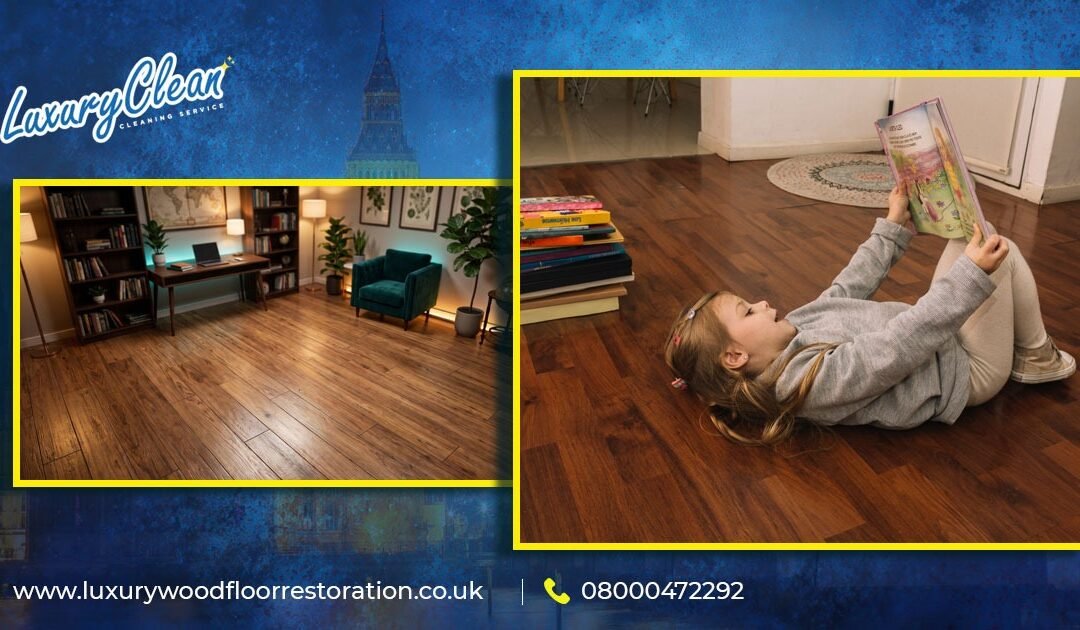
The majority of the damage to a hardwood floor is going to be something that will be apparent at a glance. You might have a darkened patch by the radiator, or a raised board right by the door. It can look as if the whole floor is going to need doing. The quote that you get for the removal and the reinstatement of the floor is going to be such that you’ll quite possibly put it off for another year.
The good news is that damage which appears to be extensive is often confined to a small area. In many instances, it’s far more practical to repair the affected boards than it is to replace the whole floor.
What does hardwood floor repair involve?
Hardwood floor repairs can involve a number of different techniques depending on the type and severity of the damage.
Small gaps between the boards can be filled with slivers of matching timber or a flexible filler. Deep scratches and gouges can often be sanded locally and the area then blended in.
Water marks and pet stains can also be dealt with via targeted sanding and colour correction (again subject to the extent of the damage caused by the moisture). If a board is cracked or otherwise beyond repair, then it can be removed and a matching replacement fitted. The area around the new board is then finished to ensure it blends in with the rest of the floor.
Period properties are a perfect example of why local repairs can be a perfectly valid option. A Victorian terrace with its original timber boards has a character that’s very hard to replicate with modern flooring. For those considering hardwood repair in Kensington, the case can be made for leaving the original boards in place and only replacing those that have actually failed. It’s a far more cost-effective option than a full floor replacement.
Why Repairs Need to Be Planned Alongside the New Finish
A replacement board will almost never have the exact same appearance as the old timber around it. The colour of the hardwood will have changed over the years through exposure to the sun, cleaning agents and regular use. A new board therefore will be very noticeable against the existing floor.
This is why the finishing process has to be considered prior to any repair taking place. The object is not simply to repair the damaged area but to achieve a consistent finish right across the floor.
For anyone looking into hardwood refinishing in Mayfair the condition of the boards in question will dictate the order of work. You’d do the repairs first and then the refinishing. That way the repaired boards get the same finishing as the rest of the boards.
When is replacing the floor the better option?
Repairing hardwood isn’t appropriate in all circumstances. If you have extensive water damage for instance you can end up with a number of boards that are warped, cupped and/or weakened. In those situations the moisture issue itself and any damage to the subfloor will have to be dealt with prior to any refinishing work commencing.
Engineered hardwood also has its limitations. If a previous contractor has already sanded the floor once or twice then the wear layer left may be too thin to sand again. You could end up exposing the core and doing permanent damage.
In those instances, it may well be more sensible to replace the section in question or indeed the whole floor rather than carry on with the repairs.
Homeowners looking for hardwood restoration in Richmond will probably think that a floor which is badly worn has effectively reached the end of its life. It doesn’t necessarily follow that if you can see the damage then the floor as a whole needs replacing. A proper inspection will tell you which boards can be repaired, which ones need replacing and whether the subfloor is still in good order.
How to Assess Your Hardwood Floor Before Calling a Restorer
A few simple observations will go a long way to help a homeowner to assess the condition of their flooring prior to arranging an inspection.
Start by checking the damaged area. If the timber is firm and the problem is just a surface stain then the damage may only require sanding and refinishing. If the board is soft or spongy then there is structural damage or rot and it may require further investigation.
Look at how far the damage extends. A problem limited to one or two boards might be amenable to a local repair, whereas damage over a number of boards may well require a more extensive job.
It also helps to take clear photos in natural daylight. Photos of the damaged area as well as wider shots of the surrounding floor can be of great assistance to a restorer when carrying out an on-site assessment.
Get the Floor Assessed Before Deciding on Replacement
A very worn hardwood floor definitely needs to be properly assessed before anyone suggests it be ripped out. The damage may be confined to just a few boards and the cost of ripping it all out may be completely unnecessary.
Luxury Clean provides free on site estimates for hardwood repair and refinishing. The assessment will tell you the extent of the damage and whether it’s something that can be dealt with on site with a local repair or a new finish or whether it’s going to require more extensive work.
A floor that appears beyond repair may in fact still have a lot of life in it. Getting the correct diagnosis first is key to enabling the homeowner to make an informed decision as to what they should do.