
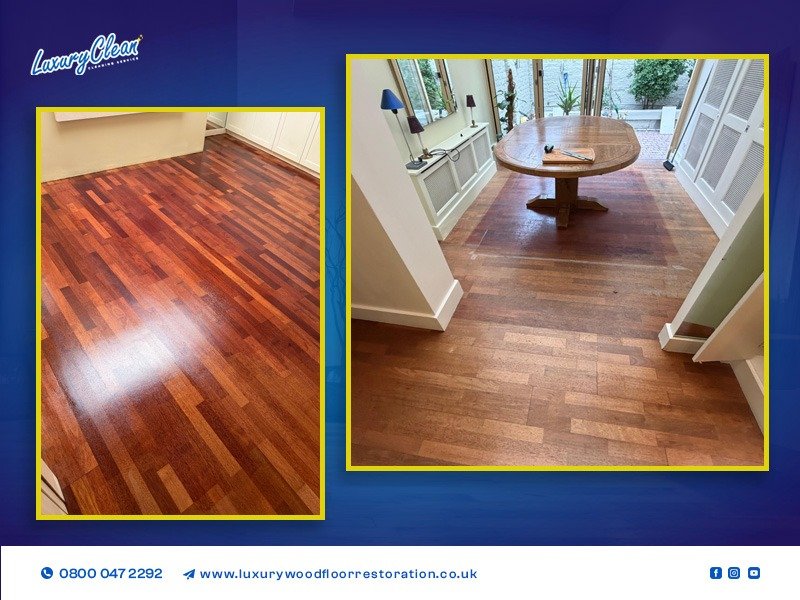
Most hardwood floors I’m called to repair in London have already been “fixed” once. Gaps filled, scratches polished, loose boards pinned down, then the same issue comes back. Not because the work was careless, but because it focused on what’s visible.
That approach doesn’t hold up in Chelsea or Mayfair homes. Timber reacts to moisture, movement, and age. Ignore those, and the repair won’t last. This is exactly why hardwood floor repair in London often fails the first time it treats the symptom, not the cause.
Warped Boards Usually Trace Back to Moisture
Warping isn’t wear and tear. It’s a response. Boards cup, lift, or crown because moisture levels change, sometimes slowly, sometimes unevenly.
In a Chelsea garden flat, I saw slight cupping along a hallway. Looked minor. The real issue sat below: poor airflow under the floor combined with lingering damp. Sanding would have flattened it for a while, but the shape would return as soon as moisture levels shifted again.
In Mayfair apartments, underfloor heating can create a different problem. Areas close to the heat dry faster, while surrounding boards hold moisture. The floor ends up moving in sections. It looks like a bad installation, but it’s an imbalance.
Skipping moisture checks is where most repairs go wrong. If levels aren’t stable, no amount of sanding or board replacement will hold its shape.
Scratches Aren’t Always Just Cosmetic
Some scratches sit in the finish. Others go deeper. Treat them the same way, and the result shows.
A common mistake is using polish to “restore” the floor. It adds shine, hides marks for a short time, then fades unevenly. Under strong daylight, especially in homes with tall windows, you start seeing dull patches next to glossy ones.
In larger Chelsea properties, this becomes obvious across open-plan spaces. One section reflects light cleanly, another looks flat. That contrast usually comes from inconsistent repair, not just wear.
Deeper scratches need proper sanding or localised work on affected boards. The goal isn’t to remove marks alone; it’s to bring the surface back to a consistent finish.
Loose Boards Usually Mean Movement Underneath
A creak is rarely just noise. It’s movement. And movement has a cause.
In older Mayfair homes, original fixings loosen over time. Nails lose grip, timber shifts slightly, and boards start moving under pressure. Adding new nails might quiet things down for a while, but it doesn’t stop the movement.
I’ve walked through properties where one room feels firm and the next slightly springy. That change usually points to differences in subfloor condition, older repairs, minor structural shifts, or past moisture exposure.
A proper fix often means lifting sections, securing boards correctly, and stabilising what’s underneath. It takes longer, but it stops the cycle of repeat fixes.
Repair Protects Character in a Way Replacement Can’t
There’s a tendency to jump to replacement. In high-end London homes, it can do more harm than good.
Original hardwood carries detail that’s hard to replicate, grain variation, natural aging, and subtle colour shifts. Replace it entirely, and you lose that.
In one Chelsea townhouse, only a small section near an entry point had warped beyond saving. Replacing the full floor would have erased its character. Instead, we repaired that area and blended the finish. The result sat naturally with the rest of the room.
That’s why hardwood floor repair in Chelsea is often the better call. The same applies to hardwood floor repair in Mayfair, where preserving original features matters as much as fixing damage.
Replacement still has its place for extensive water damage and structural failure, but it’s not the default solution.
What Proper Repair Actually Involves
Good repair follows a sequence. Miss one step, and the issue comes back.
It starts with inspection. Moisture levels, board stability, and subfloor condition are all checked before any visible work begins. This stage often reveals problems you wouldn’t spot from the surface.
Next comes fixing the cause. That might involve improving airflow, resolving a minor leak, or reinforcing sections of the subfloor.
Only then does the visible repair happen: sanding, board replacement, and refinishing. The final stage is blending. Matching tone and sheen matters more than most expect, especially in well-lit interiors.
Done properly, the repair shouldn’t stand out. It should disappear into the floor.
Small Issues Don’t Stay Contained
A narrow gap widens over time. Light warping spreads across boards. Surface scratches expose raw wood, which then takes on moisture.
Most of the larger repair jobs I see started as something minor. Not ignored, just underestimated or handled too quickly.
Address the cause early, and the work stays controlled. Leave it, and it becomes more involved than it needed to be.
If your floor shows early signs, movement, uneven wear, or slight warping, it’s worth looking beneath the surface. A proper assessment usually makes the next step clear.